


By
Atulya Chaganty

By Pam Bohline
Do AI tools help neurodivergent knowledge workers?
The rapid evolution of AI has upended the way we think and revolutionized the considerations we use to make products for end users. These dynamic changes are already impacting the workforce and transforming the way knowledge workers—workers whose primary job involves handling or using information rather than performing manual labor—execute and complete tasks core to their job function.
As of this writing, 56% of global knowledge workers are already using AI in daily workflows, including 20% of the population who currently identify as neurodivergent (ND). As neurodiversity in professional settings grows, it’s increasingly important to build effective tools for this growing population—and by extension, all users—by building frameworks designed to help product teams address the needs of neurodivergent users.
We knew at the beginning that part of the project brief was to evaluate a set of AI-supported productivity tools with the aim to increase their ability to support the unique needs of neurodivergent users.
We just had one problem: Given the unprecedentedly rapid adoption of Generative AI technology in the technology sector, clear sets of guidelines for building usable AI products for neurodivergent users didn’t yet exist.
Here's how we created the first-ever set of design heuristics for generative AI productive tools to support neurodivergent users.
Design heuristics and heuristic evaluation
Design heuristics are sets of guidelines used to develop products with successful user interfaces. Heuristics can vary from industry-to-industry, or even from product-to-product, but their goal is always to ensure a product’s interface is functional, efficient, and approachable for users. Developing design heuristics, and considering them from the start of concepting, can help improve both the speed with which teams evaluate products, and the eventual success of your products in the market.
For product researchers, design heuristics can be used to perform heuristic evaluations, i.e., formal reviews of developing products to ensure that heuristics are being adhered to. When design heuristics are used for these types of evaluations, the results can yield very similar, or even superior, results to some of the other more common forms of product evaluation (e.g., user testing). Further, heuristic evaluations are inexpensive, fast, maintain the confidentiality of sensitive or secret product development, and are useful even in very early stages of the development process.
How we developed heuristics to support neurodiversity
As a part of a two-phase exploration into neurodiverse knowledge workers and their use of AI knowledge working tools, we held one-on-one qualitative interviews with neurodivergent users who have varying familiarity with AI tools, ranging from limited experience, to some who avidly use the tools in their daily workflows. Participants provided valuable feedback on how we might design productivity tools to support neurodivergent users.
In phase two, we evaluated 10 AI-supported productivity tools based on their ability to meet ND user needs. These 10 heuristics were created based on emergent themes from our qualitative interviews which were subsequently validated and vetted in collaborative workshops with our client partners.
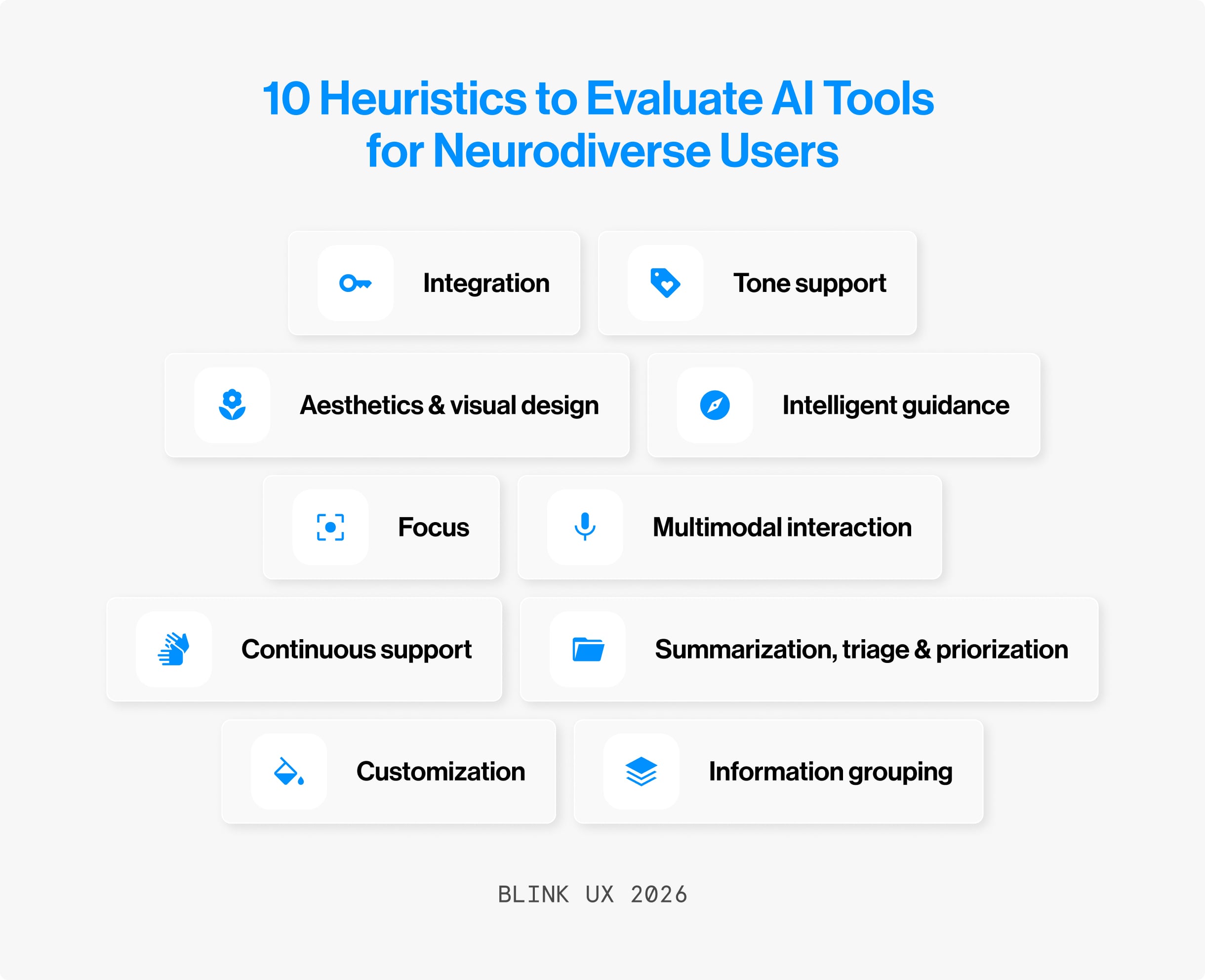
10 Heuristics to Evaluate AI Tools for Neurodiverse Users
1. Integration
Most of the time, ND users are leveraging multiple tools and systems to accomplish their core tasks. Instead of having to copy and paste between systems, the tools should integrate together to make inputs and outputs friction-free, and connections between other platforms or tools should be seamless to enhance the tool and the experience overall.
Characteristics to consider:
- How well does it integrate with other tools in its input and output?
- Is the integration robust or simply transferring information from one platform to another?
- How well does it support creating a continuous experience and/or workflow?
- Are there other reasons any friction needs to exist (i.e. data security)?
2. Tone support
Tools that use specific tones that can explain, edit, and help users understand the tone of content helps neurodiverse users create efficiency and comfort within the experience. Tools should convey voice and tone to support information exchange from platform to human.
Characteristics to consider:
- How well is it able to understand, change, and convey content into the tone users want? E.g. “more formal” or “more conversational”
- How well can it explain tone to the user?
3. Aesthetic and visual design
For the ND community, it’s important that the aesthetics and visual design of the platform are not distracting, overwhelming, too busy, or unclear. A systematic approach to visual design can help users improve comprehension, build familiarity and trust, and welcome them into the experience.
Characteristics to consider:
- Is the design purposeful?
- Does the design ease ocular strain and improve comprehension?
- Are the colors, content, and style consistent?
- Is the use of white space appropriate and considered?
- Is the application easy to scan and understandable to the user (both the individual AI features as well as the overall experience)?
4. Intelligent guidance
Guidance and support built into an AI tool can help users find answers, explain how users can interact with it, and even provide instructions to support troubleshooting itself. These attributes can help ND users stay focused and self-sufficient. A tool should show up as an assistant, partner, or coach.
Characteristics to consider:
- Is the application smart enough to collaborate with users to teach them along the way?
- Does the tool provide feedback when users need it?
- Does it provide next steps?
5. Focus
For ND users, an experience that creates an intent towards enhancing focus with limited noise and distractions can help them accomplish their task with more effectiveness. Distractions can come in a variety of formats—non-stop notifications, indicators, visual design, complex workflows, and more. A helpful tool should minimize distraction and enhance focus as much as possible.
Characteristics to consider:
- Does it enhance my attention?
- Can it create focus time and/or decrease noise and other distractions?
- Is it simplified?
- Is it clear and engaging?
6. Multimodal interaction
With different learning styles and mental models within the ND community, it is important to have flexibility, adaptability, and a variety of inputs and outputs to support these attributes. This can range from text, to speech/conversational, to visual input and outputs. Users have the capacity to consume information from a variety of inputs and outputs, so an effective tool should have the ability to use a mix of them simultaneously (i.e. text to speech and vice versa).
Characteristics to consider:
- Does it have multiple input/output options (text, auditory, visual)?
- Do the inputs/outputs work together?
- Does the design minimize distraction or visual clutter?
- Does the application have language translation?
- Is there a continuation of the tool’s functionality across different devices?
7. Continuous support
Continuous support can help ND users reduce the potential for distraction or task delay and can upskill them to become practiced, efficient, and self-sufficient. Support from a tool can come in various forms, like walk-me guides, instructions, troubleshooting tips and tricks to enhance the experience or take advantage of its full capabilities.
Characteristics to consider:
- Is the application approachable with clear instructions?
- Is there an onboarding experience?
- Can users easily access instructions and/or supportive tool tips as needed?
- Does it help users troubleshoot if it isn’t working the way the user expects or wants?
- Can the application upskill the user in the use of itself?
8. Summarization, triage, and prioritization
One of the most valuable use cases of AI for the ND community is its ability to summarize, triage, and prioritize information based on an appropriate hierarchy. This allows users to quickly grasp the details and what is the most important information they need to understand and ingest. Surfacing the most important information and reducing context switching are critical for a tool to reduce task paralysis.
Characteristics to consider:
- Does it summarize and prioritize information when the user needs information in a format or order that makes sense to them?
- Is the summarization clear, simple, and engaging?
- Does the prioritization in the tool make sense based on a set of attributes?
9. Customization
These enhancements can help anyone but are particularly supportive for the ND community because it allows users to create a set-up that works to mirror the way they think. It decreases friction, distractions, and allows users to know what to expect and become proficient in their set ups - enhancing their skills and speed, and creating comfort and mastery over their domain. Customization is a critical factor to help make an AI tool a user's own. Creating ways to make the experience support an individual user’s needs is useful in increasing efficiency and familiarity.
Characteristics to consider:
- Are there settings to customize or change styles?
- Is there an ability for shortcuts or for streamlining interactions?
- Which features can retain changes and which have to be reset every use?
10. Information grouping
Categorizing information can be a daunting mental task for neurodivergent users. When AI tools can group information automatically when it responds to user requests, it can decrease the cognitive burden on users. AI tools should automatically group information into an organized, orderly, and logical way. This is very important for the ND community as it allows users to navigate large amounts of information in an understandable and clear way.
Characteristics to consider:
- Does it compartmentalize tasks and information in a comprehensive and organized way?
- Are the answers the AI provides clear and concise?
- Is the structure of the grouping logical and obvious?
- Are groups labeled?
Citing the heuristics
You may cite these heuristics in your own work. Please credit Blink UX and link back to this page.
Atulya Chaganty is an Interdisciplinary Product Designer and Strategist at Blink who specializes in system thinking and strategic problem solving for the near present to the far future. Prior to Blink, Atulya worked on projects from end-to-end for NASA, Reebok, NIKE, T-Mobile, Boeing, and the Washington State Department of Transportation, as well as many other social impact projects at varying scales.
Pam Bohline is Research Director at Blink. She focuses on business purposes and connecting them with consumer and user needs through various research methods, and she's passionate about people, processes, and products.
Huge thanks to our collaborators in this endeavor: David Muñoz, Robert Youmans, Rebecca Lawson, and the Workspace UX Research team