



By Jill Hannay

By Sam Woods
Why is it that only 5% of companies using generative AI are achieving meaningful business value?
I’d argue the problem isn’t the AI itself: It's the foundation the AI is trying to operate on. Across industries, an uncomfortable pattern is emerging: the faster enterprises invest in AI, the more misaligned their underlying systems become.
The foundation for all great AI systems: organized, strategic content
As consumers, we understand “content” as media we engage with directly—copy, images, videos, blogs, social posts, podcasts, and the like. At the enterprise level, content is information—text, media, and data—treated as a strategic, governed asset managed across departments within a unified content ecosystem. Governance and intent span organizational structures, system architectures, and the text itself.
Why the condition of your content prevents AI success
Most enterprises still rely on long, unstructured pages of content stored across siloed systems. AI cannot parse these pages reliably, it cannot reuse them at scale, and it cannot deliver accurate, brand-aligned outputs if the underlying content is inconsistent, outdated, or poorly governed. This fragmented content foundation results in a piecemeal agentic experience, with underperforming chatbots that provide low-quality or inaccurate answers and a frustrating user experience.
Many enterprises have an inadequate data structure, inconsistent schemas, incompatible systems, and weak governance that prevents value realization and undercuts AI initiatives. The findings in MIT’s “State of AI in Business 2025” report are clear: Most AI failures arise from AI's inability to verify information, lack of operational workflows capable of incorporating GenAI safely, and poorly structured enterprise data. But these malfunctions can be remedied through higher fidelity content—content with structure, treated as data, with tighter governance.
What is content modernization? What makes content “AI-ready”?
Content modernization is about transforming content into data by providing a contextual wrapper, allowing AI to work reliably and improving its outputs while avoiding extra costs.
Structured content reduces maintenance overhead, improves accuracy across channels, and creates a future-ready foundation. Providing LLMs and agentic machines the structure they need to operate at peak efficiency unlocks many secondary benefits as well, making content easier to find, deliver across multiple channels, and repurpose.
How structured, upgraded content sets the stage for AI success
Organizations that see measurable value from AI have built structured, governed data ecosystems that feed consistent, reliable content to models. Organizationally backed content design, supported by well-structured content, unlocks the operational efficiency AI promises.
When content is structured, governed, and centrally managed, organizations see major gains:
- Improved findability. Structured content makes information easier for AI systems to index and retrieve, enabling more accurate and reliable search, chat, and agentic experiences.
- Streamlined processes. Modular content reduces manual effort, saves time, and accelerates delivery. It can be used and re-used across web, mobile, and voice, reducing content production costs and enabling AI to format content for each context.
- Future-ready reuse. Structured content becomes a reusable asset library. AI can combine, enrich, and personalize content chunks, reducing development time and avoiding expensive retrofits.
Without a solid foundation, enterprises face slow launches, inconsistent user experiences, and real compliance risk, especially as AI produces more content that needs to be governed, maintained, and, above all, accurate.
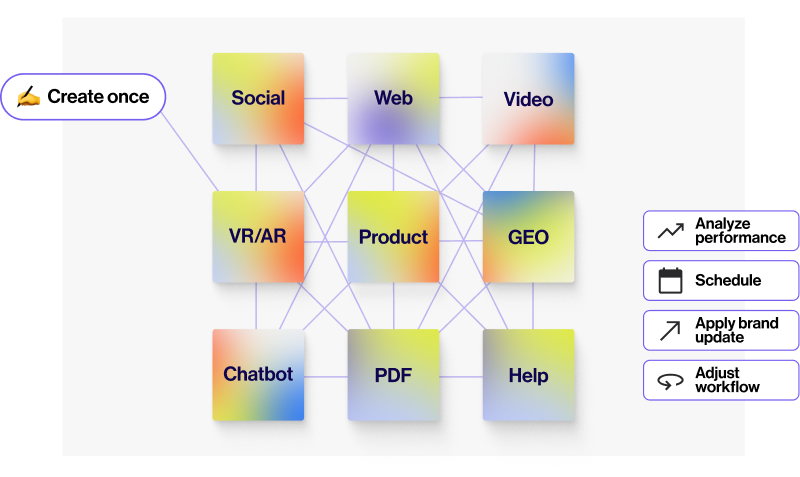
How to transform a fragmented system into an AI-ready one
Solutions have to be tailored, especially when multiple systems, products, and teams are involved. Our content modernization approach begins by identifying the symptoms in the current content landscape.
Step 1: Diagnose the ecosystem
We start with a content audit centered around real user journeys. We evaluate whether content meets AI‑compatibility best practices, flows logically for users, and reflects internal standards. At the same time, we conduct stakeholder interviews to understand governance gaps, ownership challenges, and cross‑team friction.
We use this data to make a diagnosis that clarifies the business goals, surfaces systemic risks, and reveals what needs to change.
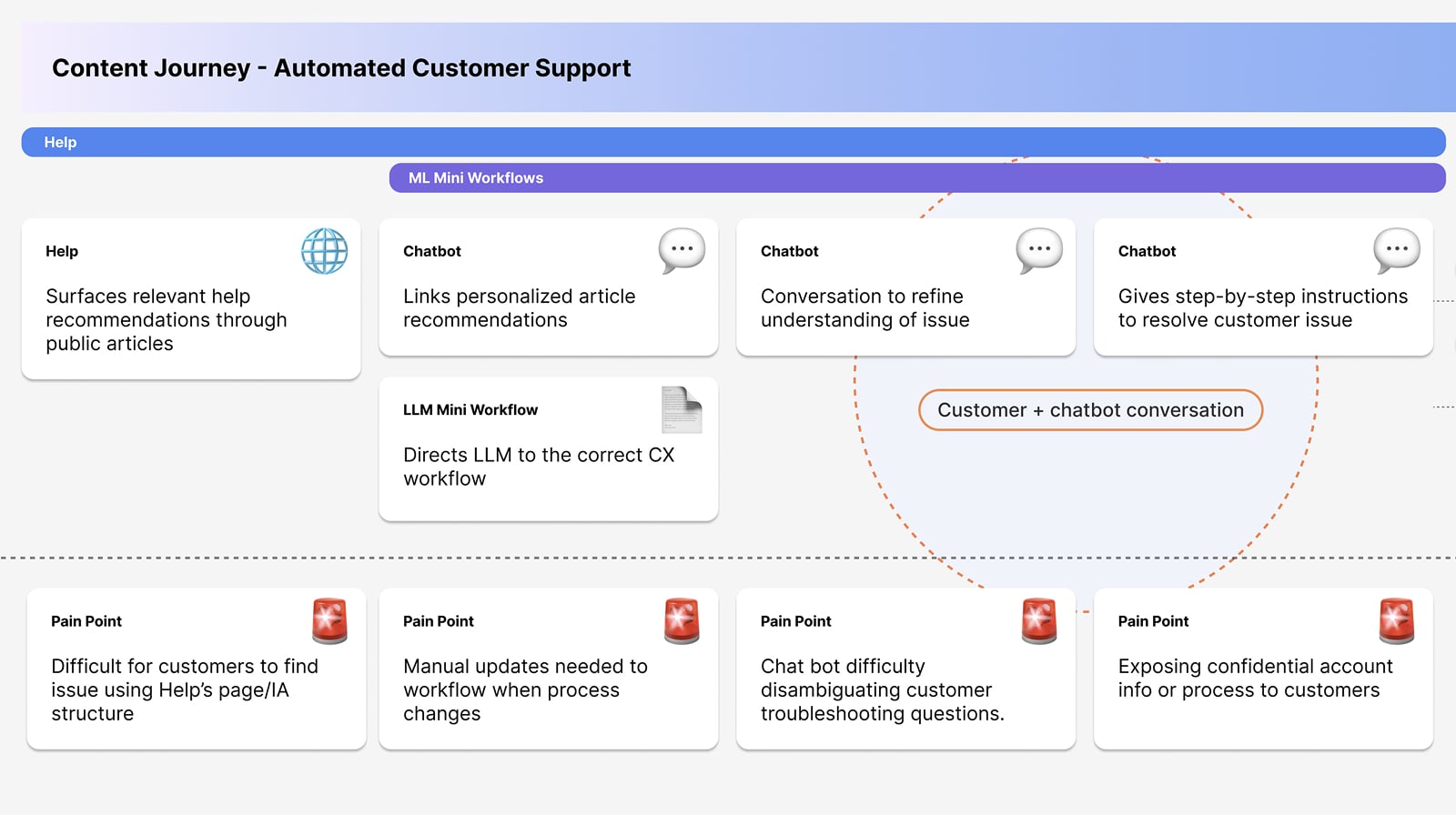
Step 2: Define the strategy
With the audit complete, we create a North Star content vision and present a phased modernization roadmap at a strategy workshop. The workshop gives organizations a shared direction and builds early alignment across teams and leaders.
Step 3: Design the content system
After defining the content types and components that form the system’s backbone, we can design a map of how content interacts within the ecosystem. This map includes metadata, taxonomy, and governance frameworks.
Then we build the content model: the reusable structures that allow you to write once and publish everywhere.
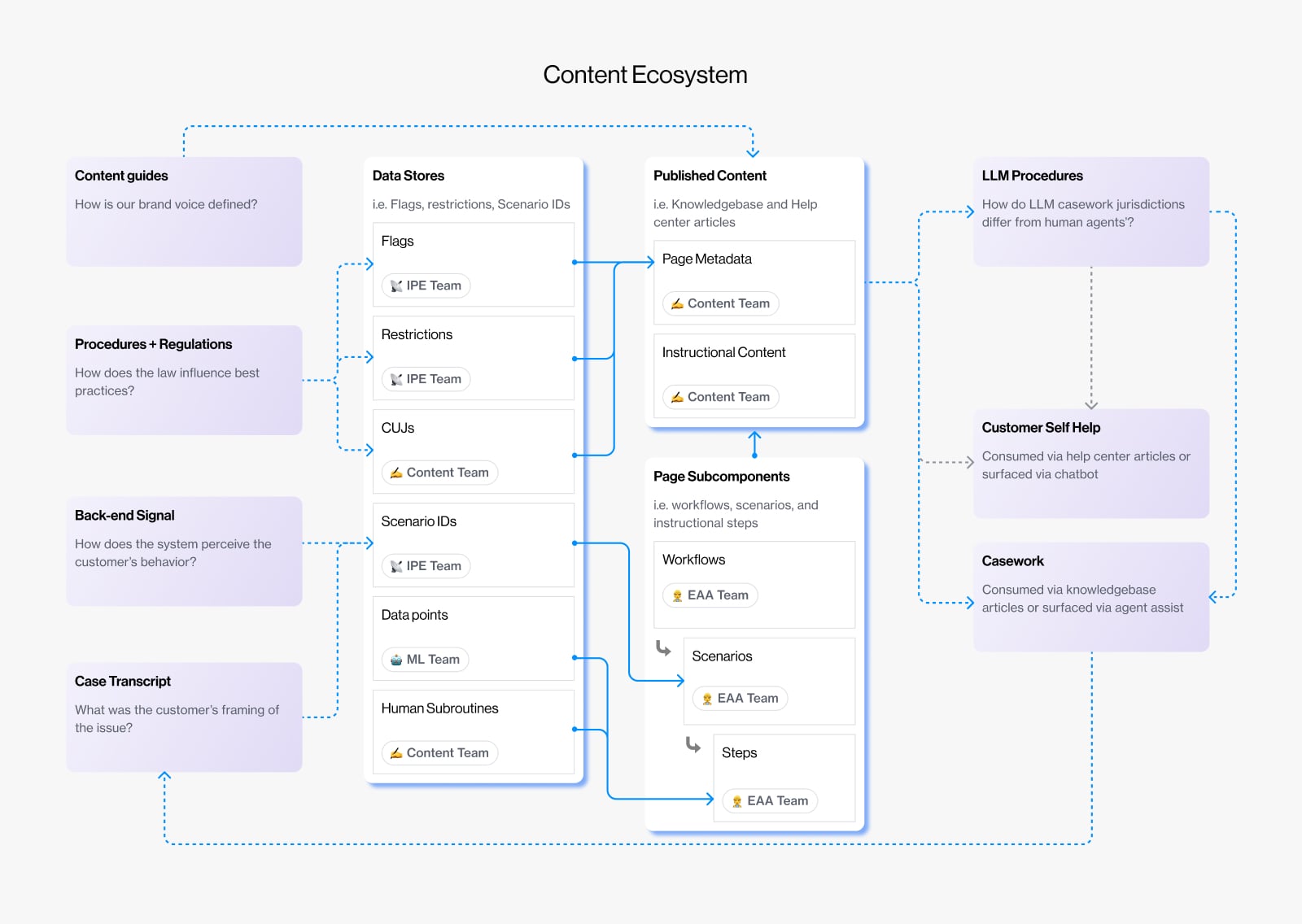
Step 4: Enable sustainable operations
As noted in a McKinsey Global Survey, “Transformations are 5.8 times more likely to succeed if CEOs communicate compelling change stories and 6.3 times more likely when senior leaders share aligned messages widely.”
To ensure a unified experience for customers, employees, and AI systems, we align stakeholders around a clear vision for content and deliver content authoring guidelines, templates, and governance processes. This unifying approach builds momentum and strengthens the initiative, enabling teams to reduce duplication, make content operations more predictable and scalable, and shorten time‑to‑market.
Content modernization is an ongoing practice
A strong content foundation is what enables AI to operate confidently across the entire enterprise. But just like a design system, a modern content foundation requires ongoing stewardship to stay up-to-date.
As AI accelerates, the organizations that actively maintain their content systems will unlock greater accuracy, stronger governance, and scalable performance. Those that keep trying to scale with a fragmented foundation will accumulate content debt and fall behind.
Want AI that lives up to its promises and actually drives growth? Look to your content.
⁕⁕⁕
Jill Hannay is Design Director at Blink and part of Blink’s design leadership in Seattle, guiding cross-functional teams across product vision, enterprise UX, and content strategy. She focuses on creating innovative experiences that elevate human needs while preparing design and content for what comes next.
Sam Woods works with companies to make their content AI-ready and develops content strategies that propel brands and enterprises forward. At Blink, he combines structured content expertise with a narrative mindset informed by his background as an author, screenwriter, and playwright.